
Licensed psychotherapist · 10+ years · EMDR · Lifespan Integration · Certified HeartMath trainer · English, German, Hebrew · Online, worldwide
Licensed psychotherapist · 10+ years · EMDR · Lifespan Integration · Certified HeartMath trainer · English, German, Hebrew · Online, worldwide
Online psychotherapy in English
For highly sensitive adults who notice everything, recover slowly, and are exhausted by the effort of keeping that invisible.
Book a first session50 minutes, no commitment beyond it.

Finding the right therapist is hard enough. Finding one who works in your language, understands the world you live in, and doesn't need three months to catch up on context — and is then also available where you live — narrows the field considerably.
Then there's the other problem. You may have already done therapy. Perhaps a lot of it. You can describe your patterns fluently. And you're still here, doing the same things, wondering whether this is simply what you're like.
Working online removes the geography problem. It doesn't solve the second one — but the way I work is built specifically around it.
Most of the people I see are highly sensitive. They notice more than the people around them, need longer to recover from ordinary demands, and have built a life that quietly manages both. Frequently they've been the person others rely on.
They come to me because something isn't shifting.
You notice everything, recover slowly, and have organised your life around not being overwhelmed.
Read moreDiagnosed late, or still wondering. High-functioning on the outside, exhausted by the effort it takes.
Read moreThe holiday didn't fix it. Rest doesn't restore you. You're still braced when there's nothing to brace for.
Read moreFrom the outside your life works. Inside you've been on alert for as long as you can remember.
Read moreFour different doors into the same work. If you recognise yourself in more than one, that's usual — they tend to travel together. And if you've already done years of therapy without it translating into change, that has its own page.
Regulate → Integrate → Consolidate. Physiology first, so the deeper work has something steady to land on.
We begin with your nervous system rather than your history. Using HeartMath coherence training, you learn to recognise activation and shutdown as they happen, and to shift state deliberately. It's measurable, and it's useful within the first few sessions.
With more stability to work from, we process what's still driving the reaction — using EMDR or Lifespan Integration. This is where the gap between understanding and response starts to close.
Then we make sense of what the pattern was protecting, and translate the change into decisions, relationships and how you see yourself.
Most therapy begins and ends at understanding. Most regulation work stops at technique. I sequence them.
You can understand exactly why you react the way you do — and still watch it happen again next week.
Sessions run by secure video. You'll get a link before each appointment — nothing to install. All you need is a private space, a stable connection and headphones.
50 minutes, usually weekly to begin with. EMDR and Lifespan Integration sessions sometimes run longer; we'd agree that in advance.
I work with English-speaking clients across Europe and beyond. If you're outside Europe, time zones become the practical limit rather than anything else — write to me and we'll see whether the hours work.
My working hours are Central European Time. When you book, times are shown in your own time zone. If you move country or travel, we adjust rather than stop.
For sensitive people online is often actively better: your own space, no commute, no waiting room, and you can settle immediately afterwards instead of walking back out into the street. Online work is well suited to most of what I do, including EMDR, which is routinely delivered by video. It is not appropriate if you're in acute crisis or need someone who can reach you quickly in an emergency. If that's the situation, local in-person support is the right thing, and I'll say so directly.
| Individual session | €150 · 50 minutes — including the first |
| Foundation Block | €1,120 · 8 sessions (€140 each) |
| Regulation Baseline | €250 · 90 minutes — HeartMath baseline, autonomic and trigger map, written summary |
Sessions cancelled with less than 48 hours' notice are charged in full. Full fee details →
Step one
Fifty minutes by video. You say what's going on and what you've already tried; we map where the difficulty is likely sitting. If I don't think I'm the right person, I'll say so and suggest who might be.
Step two
If it's a fit, we begin. The first few sessions map where you are — what sets you off, what you do to manage it, what you want to be different.
Step three
Less time spent activated. Faster recovery after difficult conversations. More room between what happens and how you respond.
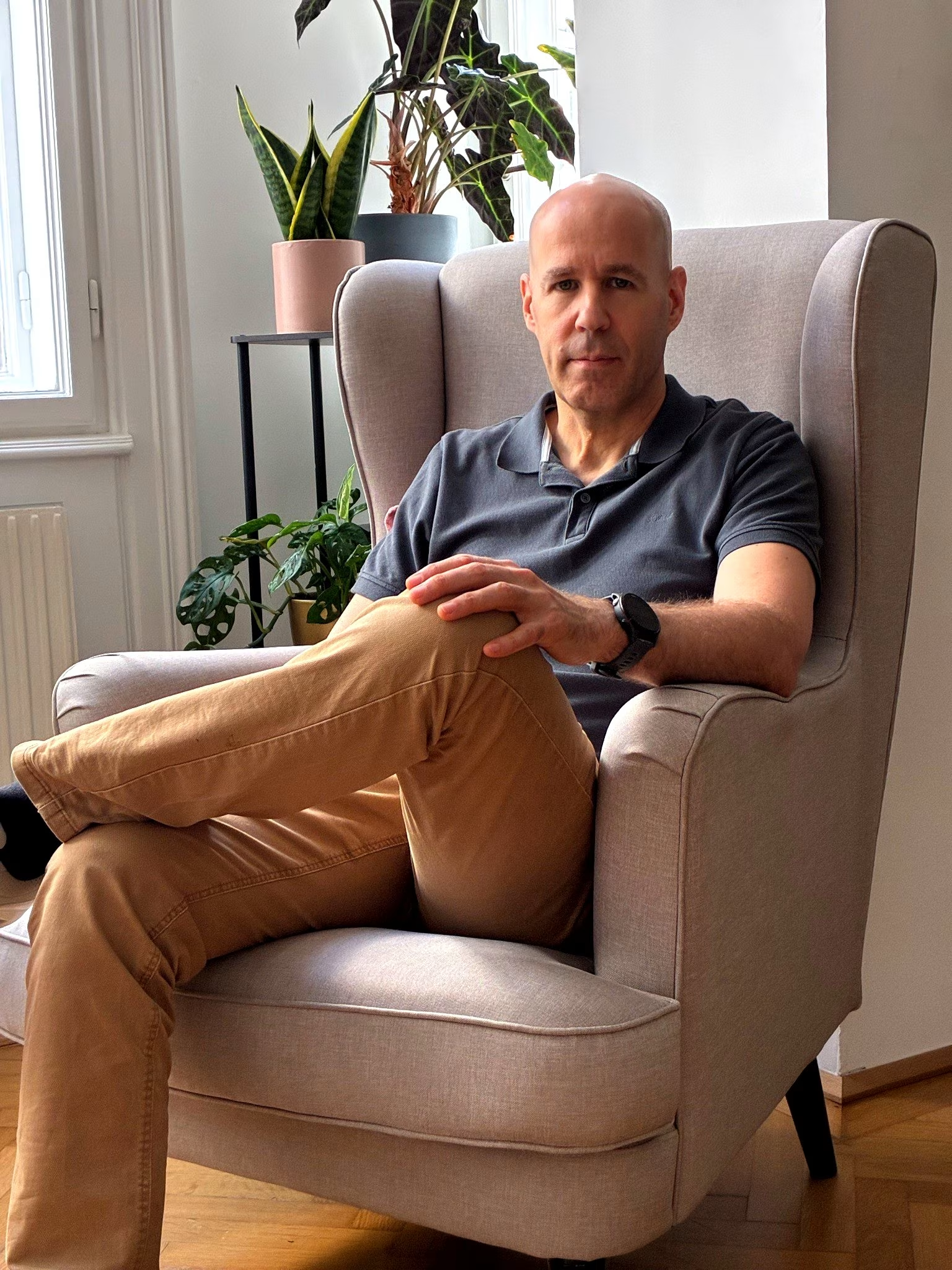
I'm Rotem Hess, a psychotherapist licensed by the Austrian Ministry of Health and based in Vienna. I've been working psychotherapeutically for over ten years, in private practice and in clinical settings including psychiatric inpatient and outpatient care and rehabilitation.
Before psychotherapy I worked as a VLSI engineer and in product management. That background still shapes how I work: I'm interested in which layer of a problem is actually maintaining it, and I'm comfortable with measurement — which is unusual in a psychodynamically trained therapist, and useful.
I trained in psychodynamic psychotherapy and group analysis at the ÖAGG, and in EMDR, Lifespan Integration, HeartMath coherence training and neurofeedback.
Yes. Online therapy across borders is common, and for English-speaking people living where their own language isn't widely spoken clinically, it's often the only way to find a good fit. What matters practically is time zones and whether you have local support available if you ever need urgent care.
For most of what I do, yes. Research on video-delivered psychotherapy, including EMDR, generally finds outcomes comparable to in-person work. What matters more than the medium is the fit between you and the therapist, and whether the approach suits the problem.
Yes. EMDR is routinely and effectively delivered by video, using on-screen bilateral stimulation or self-administered tapping. I'll explain exactly how it works before we start.
€150 for a 50-minute session, or €1,120 for a block of eight (€140 each). The first session is charged at the standard rate. For comparison, private self-pay therapy typically runs €80–160 in Austria, €100–150 in Germany and €175–250 in Switzerland.
That's one of the most common reasons people contact me, and it's worth taking seriously rather than treating as a sign that therapy doesn't work for you. Often the missing piece isn't more understanding — it's that the understanding never reached the system generating the response. More on this →
Yes — I work in English, German and Hebrew. This page is written in English because most of my online clients prefer to work in it, but you can choose.
Fifty minutes by video. You leave with a clear read on what's maintaining the problem — and an honest answer about whether I'm the right person for it.
Book a first session