
Licensed psychotherapist · 10+ years · EMDR · Lifespan Integration · Certified HeartMath trainer · English, German, Hebrew · Online, worldwide
Licensed psychotherapist · 10+ years · EMDR · Lifespan Integration · Certified HeartMath trainer · English, German, Hebrew · Online, worldwide
About
Licensed psychotherapist. Formerly an engineer. Highly sensitive myself — which is not incidental to how I work.
Book a first session50 minutes, no commitment beyond it.
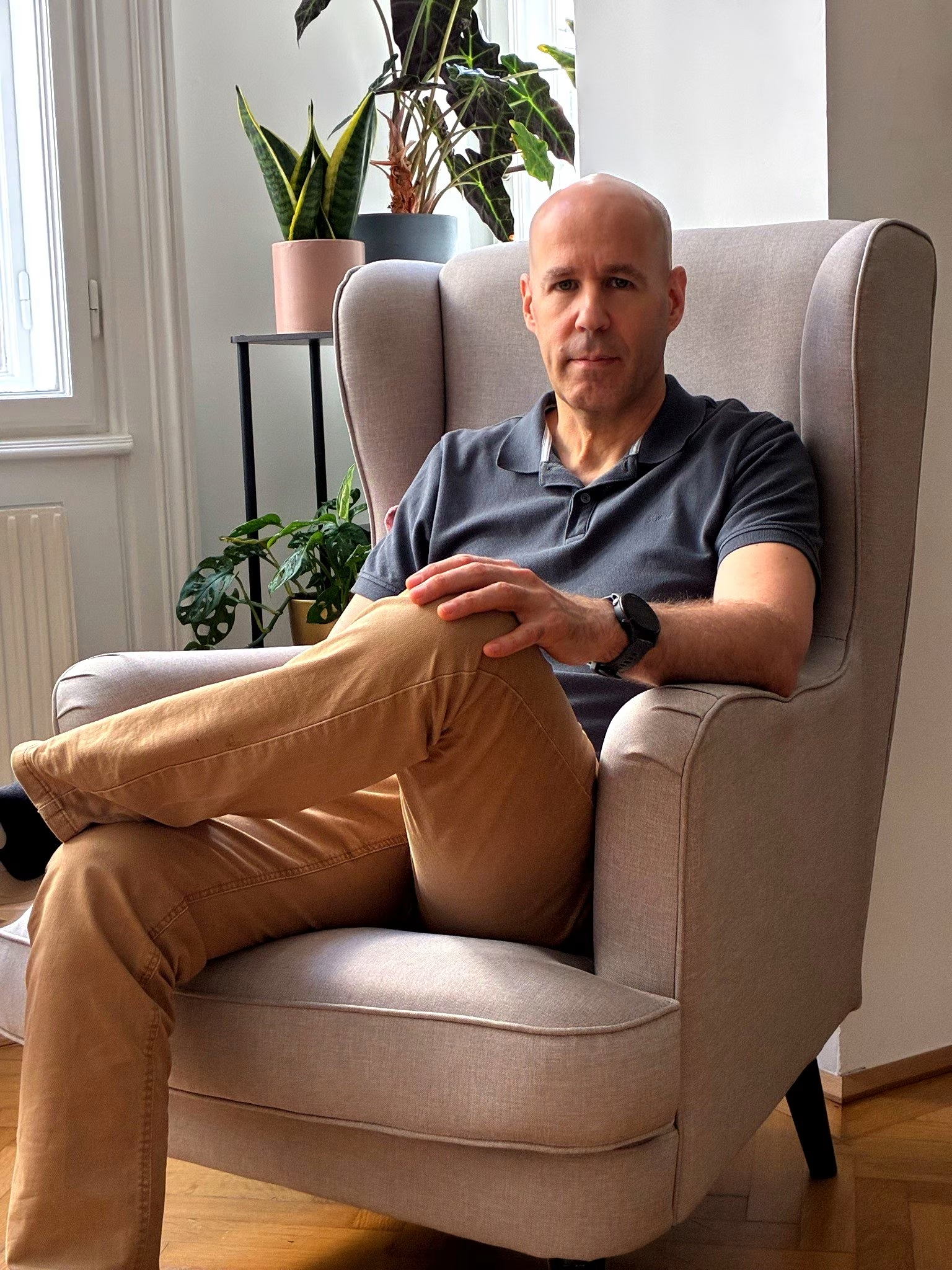
Before this I worked as a VLSI engineer and in product management. Chip design, then products — technical work, and the question of how technical decisions get made.
What eventually pulled me away wasn't dissatisfaction with engineering. It was that the questions I found myself most interested in weren't engineering questions. Why capable people repeat patterns they can see straight through. Why understanding a problem so often fails to resolve it. What's actually happening when someone knows exactly what they're doing and does it anyway.
I retrained, and I've been working psychotherapeutically for over ten years — in private practice, and in clinical settings including psychiatric inpatient and outpatient care and rehabilitation.
A way of thinking about layered systems.
In engineering, the layer where a fault shows up is very often not the layer causing it — and treating the symptom layer produces confident work that changes nothing.
People are the same. Someone's difficulty might sit in their physiology, or in experience that hasn't been processed, or in the story they've organised themselves around. The intervention that helps depends entirely on which.
The question I'm always working on is: which layer is holding this in place?
That determines what we do. And the advantage isn't the number of methods I've trained in — it's being able to tell which one the problem in front of me actually needs.
I'm highly sensitive myself. I mention it because it explains the shape of the work, not as a credential.
It's part of why the sequence begins with capacity rather than with history. Sensitive systems reach their limit sooner, and processing difficult material before there's enough stability to hold it produces overwhelm rather than change — a common and preventable way for therapy to stall.
It doesn't mean I'll assume your experience matches mine. It means you won't have to explain the basics, and I won't mistake sensitivity for fragility.
I'm active rather than silent. I ask questions, make connections, and say what I'm noticing. I'll slow things down when something needs staying with, and move when staying isn't useful.
I don't think therapy should last forever. I think it should get somewhere, and then you should get on with your life.
I'll be honest with you about what I think is happening and about what I don't know — and I'd rather tell you I'm not the right person than take you on out of politeness.
Qualifications
| Since 2020 | Private practice, Vienna and online |
| 2022–2024 | Rehabilitation Clinic Montafon — inpatient psychotherapy |
| 2020–2021 | AKS Health Centre, Bregenz — outpatient rehabilitation |
| 2018–2019 | ÖAGG outpatient clinic — psychotherapist under supervision |
| 2017 | Donau Hospital, Vienna — psychiatry, inpatient and outpatient |
| 2016–2017 | Sigmund Freud University outpatient clinic — psychotherapist under supervision |
| 2014–2016 | Sigmund Freud University outpatient clinic — clinical assistant |
Inpatient psychiatry and rehabilitation aren't glamorous places to train, and they're where you learn what actually helps people when they're at their least resourced. I'd rather have that behind me than not.
Online, in English, with clients across Europe and beyond — and in person in Vienna.
English, German and Hebrew. You choose which we work in.
50 minutes, usually weekly to begin with. Full fees →
A first session, by video or in Vienna.
Psychoanalytically trained in Vienna. Working online, worldwide.
You tell me what's going on; I tell you honestly whether I think I can help.
Book a first sessionIt is only when the self is allowed to unfold in its own way that its innate tendency towards healing can emerge.
Marion Milner